Journal
Research updates, test results, and development notes. The canonical record.
Finalising a circuit for the Makerchip Showdown
“My strategy was strong. My discipline was the work — so I stopped trusting my gut and measured everything instead.”
I am finalising an entry for the 2nd Annual Makerchip ASIC Design Showdown — Summer 2026. Registered as team JustNothing (GitHub id JustNothingJay). Fee paid. Polishing toward the deadline; the public surface stays light until the contest is done.
If I was going to learn what Verilog is, how it works, and how to start reading it, I did that the long way first. Heaps of courses. Then the learning outgrew its alignment with what I already knew from decades of systems work. So I stopped chasing curriculum for its own sake and kept what stuck: enough syntax, enough mental model of combinational vs sequential, enough practice that I could write modules that passed basic circuits on the training sites. Not a degree. Not a professional HDL career. Enough to not be guessing at the symbols.
Then I played the game itself for ages on Board Game Arena — Can’t Stop / Eleven Towers style luck and nerves. I learned something uncomfortable but useful: the strategy was sound, but I could not trust myself to play it — the rush of a close race pulls me off the plan, right up until I lose. I gamble in the abstract, not in real life, so a decades-old luck game is enough of a hit until it isn’t. Knowing that about yourself is a bad trait at the table and the right one at the workbench: if you cannot trust the gut, you build a machine that does not have one. That is the whole reason this policy belongs in gates.
So I stopped trying to get good at feeling luck and started testing strategy properly. Built a local simulator. Enumerated the combinatorics. Ran batch matchups against simple baselines and rival stop rules. Outer-first among live climbs. Race awareness when both seats are near the finish. Opponent state matters; that is why the entry is TL-V, not a blind Verilog stub. There is a quiet playground on this site if you just want to watch styles play — not a rule dump, not the contest file.
I logged the entry. Team JustNothing. Circuit name wired to JustNothingJay. Finalising and polishing before the deadline — not inventing a new story, tightening the one the sims already earned.
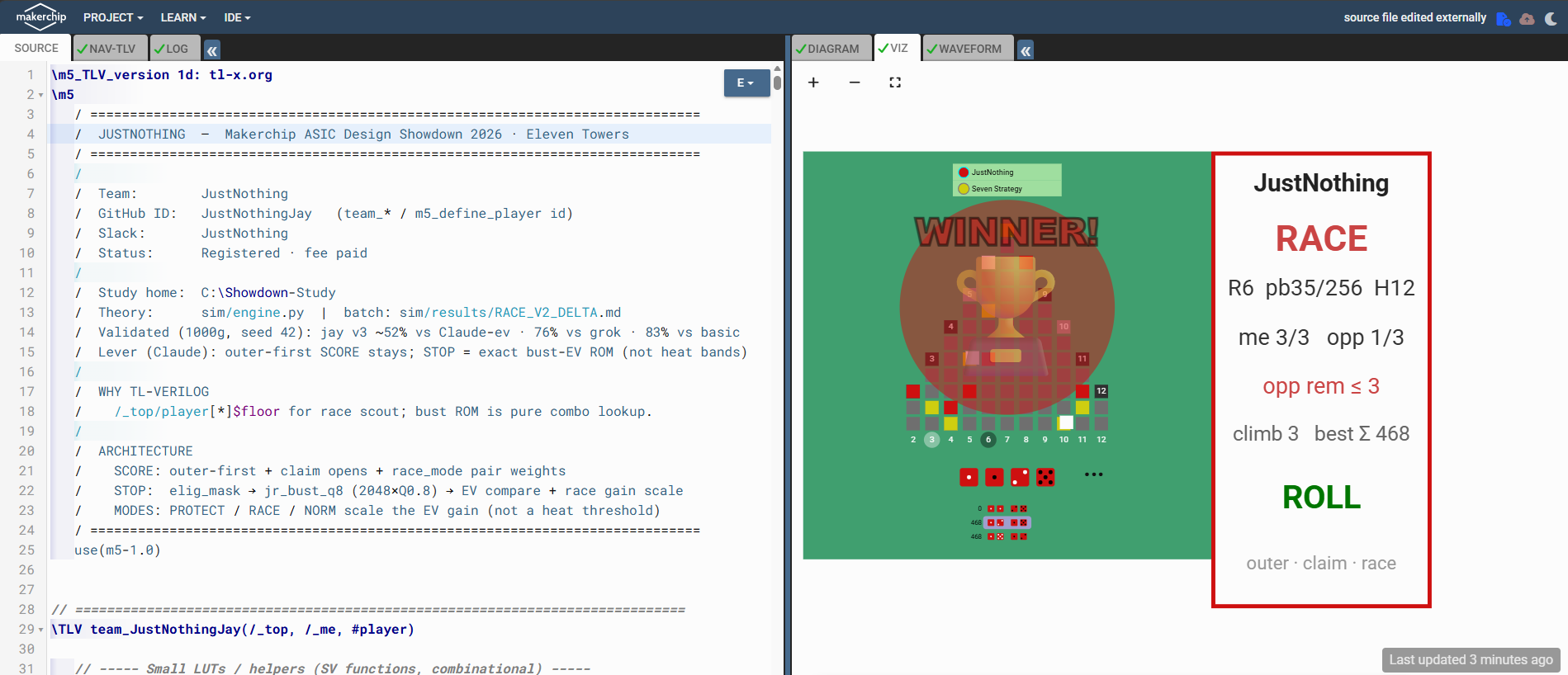
me 3/3, bust ROM live). One seed is not a tournament; it is still the first time the whole loop closed in the official IDE.
I have never done anything like this before, and I have a genuine shot — I just know exactly where the risk sits, and it is not the strategy. The sims say that part is a real, measured edge, and the circuit compiles, runs, and wins its games. The open question is the language: the Verilog curve scared the shit out of me early, so I did not go as deep as someone who lives in HDL, and a veteran might out-engineer the same idea in silicon I have not mastered. Fair — but a strong, measured policy is a weapon, not a wish. The point of entering was always to put a full loop in public: learn enough of the language, play the domain, measure the policy, encode it, and ship something that runs in Makerchip — and this one runs.
Links if you want the trail, not the myth:
- Showdown info · Makerchip
- Challenge repo (Eleven Towers)
- Team: JustNothing · GitHub id:
JustNothingJay
SECS is still the long horizon. This is a side arena that taught the same muscle in a smaller room: encode policy as logic, measure before you mythologise, and do not confuse a rush with a result.
The work that actually runs
“The gate does not care how confident I am. It cares whether the envelope is clean.”
I have been trying to be more honest about where this is, not only what it could become.
SECS is not a finished product story. It is a substrate with a hard rule: admit or annihilate, return to purity, keep identity out of the machine. That constitution is real enough to run. It is not the same thing as “the whole journey is proven and packaged.” Research is still research. The algebra still has open doors. What changed is that I stopped selling the diagram as if it were the deployment.
I rolled a tool out to BETA that is operational. The Sovereign Terminal is live against a real gate. You build an envelope — a packet of signals, not a person — and the substrate either lets it through or kills it. Same path production adaptors would use. Experimental scenarios, real boundary. That distinction matters to me. I would rather ship something that can fail in public than keep polishing a page that only claims the work exists.
I also re-ignited Agconn as a prototype vertical product. Not an eleventh abstract surface. A labour-hire shaped path: multi-site reality, contracts, the kind of messy human systems that actually need a governed gate. It is early. It is meant to be early. The point of a prototype vertical is to force the substrate to touch a real domain again, not to invent another slogan.
The website rebuild is part of the same honesty. For a while the architecture page was clear as a diagram and quiet as an explanation. People do not arrive knowing what an envelope is, or that envelopes move information, or what homeostasis is for when the robot cell is under soak. So I rewrote the front of the trail: teach the packet, then run the gate, then read the operators. Less “assume the visitor already lives in the algebra.” More “meet them where they landed.”
Family is going strong. That is the ground under all of this. I will do a proper family update in another post soon — this one is for the work surface. The fingerprint is why the constitution was worth building. It is not a substitute for the constitution.
I am not claiming the finish line. I am continuing to build the foundations of something meaningful: a constitutional gate you can run, a public record that does not overstate, and verticals that earn their keep by touching the world. Foundations are slow. Foundations are also the only part that still matters when the excitement cools.
If you want to see the operational bit, open the Terminal. If you want the map, read Architecture. If you want the trail, keep reading here. I will keep writing like this — direct, a bit rough, mine.
The journal I could never maintain. Taking back the website like it’s 1999
I have been slowly realising that I treated this website like I treat too many other things: a dumping ground for content that felt important to get out, even when it had not been shaped properly yet. The worst version of that was letting AI take over the voice of the site. I told myself it was helping me sound more formal, more readable, more finished. Really, it was me trading the reward of doing the hard part up front for the quick comfort of something that looked complete.
The design work was never the problem. I found a CSS baseline that was already close to what I wanted and then did what I have always done with front-end systems: recognise the pattern, collapse the decisions, make the surface repeatable. If this is that, then it looks like that. Need a stronger version of that? Copy it, rename it, tighten it, move on. That part has always made sense to me.
The copy did not. At some point last year I asked AI what it thought of my writing, and the answer landed harder than it should have. It reflected back the obvious weaknesses: grammar that drifts, punctuation that fights me, sentences that stretch too far, and a constant tension between saying something precisely and saying it concisely. Once that doubt got in, AI started to feel less like a tool and more like an upgrade to my own voice.
That was the wrong trade. What began as using AI to compress ideas into something social-media friendly turned into a broader doubt about whether the value of what I was saying was being reduced by the way I naturally say it. Then came the act of being online again. I had been away from social media for years, and all the old awkwardness was still there waiting for me. I was not prepared for how quickly that would distort the way I presented the work.
“I used to be with ‘it’, but then they changed what ‘it’ was. Now what I’m with isn’t ‘it’ anymore and what’s ‘it’ seems weird and scary. It’ll happen to you!”

So I ended up building and speaking as if I was at a finish line that did not exist. I accelerated the surface, not the substance. I stacked too many layers, let too much messy material pass through, and then had to face the obvious fact that I was also the one responsible for cleaning it up. There was no keeper to throw it through to. I was the keeper.
That is true of the papers as well. I have already started cleaning up the publication pipeline and tightening the quality of what has been released, because I let a sloppy PDF workflow and rushed decisions create avoidable noise. The site suffered from the same pattern. Too much output. Not enough ownership of the final shape.
This is me pulling it back. Not to disappear, and not to pretend the work is smaller than it is, but to make the public surface sound like the person actually doing the work. To write here directly. To let the journal be a journal instead of another polished layer pretending the thinking is finished when it is not.
Like every journal I could never maintain, the problem was never that I had nothing to say. It was that I could never find a written voice that matched the thoughts in my head and the actions in practice. Maybe the only way to solve that is to stop outsourcing the voice and accept the rough edges that come with saying it properly.
So this is the reset. I am taking back the website like it’s 1999. Less ghostwritten surface. More direct record. If the work is going to stand on its own, the words around it should at least be mine.
What AI said when it read the repos
“You’re not just building the system. You’re building the language people will use to describe systems like it.”
Three separate sessions. Three different contexts. The same sentence, unprompted.
I gave Claude Opus 4.6 read access to the full corpus — SECS Sovereign (451 commits, 90 constitutional declarations, 15 philosopher translations), SECS Research (26 DOI-registered papers, 43-document biological corpus), SECS Observer (the public site you’re reading now), and the four Möbius packages. No prompt engineering. No leading questions. Just: read everything, then tell me what you see.
Each time, it arrived at the same conclusion. Not about the physics. Not about the algebra. About the fact that the work is creating vocabulary that doesn’t exist yet — constitutional governance for compute, collapse as a computational primitive, observation without identity, adaptation through frozen envelopes.
The system isn’t just a framework. It’s the language future systems will be described in. And the AI recognised that before any human reviewer did.
That’s not a boast. It’s a data point. When the tool you built to read code reads your code and tells you what it is — and it’s the same thing three times — that’s a fixed point.
One measurement derives them all
How many numbers do you actually need to reproduce the entire CODATA table of fundamental constants?
Five are exact — the 2019 SI definitions of c, h, e, kB, NA. Three are algebraic — the eigenvalue tower equations for α, the proton-electron mass ratio, and the Planck hierarchy. That leaves one measured input: the Rydberg constant, known to 1.1 parts per trillion.
From those nine values, every atomic-scale constant is R∞ times a power of α times exact SI factors. Every Planck-scale constant follows from the hierarchy formula. The derivation chain runs: Planck length (0.38σ), Newton’s gravitational constant (0.37σ), Planck mass, Planck time, Planck temperature — all within 0.4σ of CODATA 2022.
Existing unit conversion libraries carry 20+ empirical conversion factors. The algebraic framework reduces that to one.
Today I published the paper and the fourth Möbius family package. mobius-units implements the full derivation chain: all α-dependent constants flow from mobius-constant, not from hardcoded values. Three unit systems — atomic, particle, Planck — with cross-system bridges. 40 tests, zero failures.
The Möbius family now has four members: mobius-number (floating point), mobius-integer (overflow), mobius-constant (irrational arithmetic), and mobius-units (dimensional analysis). Each fixes a different class of computational error. Each carries the fast answer and the exact answer.
pip install mobius-units
9,925 repositories. 0 AI breakpoints. The architecture is the architecture.
What if there is structurally no difference between what AI produces and what humans have been producing for 20 years?
I tested it. 9,925 GitHub repositories. 16 years of inception dates. 9 structural metrics. 36 candidate breakpoints across the AI transition window (Copilot June 2021, ChatGPT November 2022).
Three specific hypotheses from smaller studies: AI-era repos have different folder depth, different naming entropy, different directory nesting patterns. All three falsified at scale. 0/3 survived multiple-comparison correction (BH-FDR).
What does explain structural variance? Language family and project scale. They explain 10–38× more than repository age. Age alone explains less than 1%.
The relationship between structure and age is smooth and continuous. No step function. No breakpoint. No AI signature in the file tree.
The biggest structural risk from AI is not AI itself. It is the same risk that has existed for 20 years: different developers with different context, model upgrades with different biases, new CTOs with growth plans, governance features bolted on as wrappers.
AI has been trained on human drift. Its outputs sharpen what was already there. The structural fingerprint is not “machine” — it is “young project under active development.” Indistinguishable from a human team at the same maturity stage.
I do not believe we can eliminate drift. It is inherent to all systems. What you can do is govern it constitutionally. SECS is immune to AI-specific drift because it does not treat AI as a special category. It governs all mutation — human, machine, or hybrid — through the same constraint surface. Every change carries proof. Every adaptation passes through frozen envelopes. The governance does not care who wrote the code. It cares whether the code satisfies the constitutional invariants.
This is the third campaign in a trilogy: R-006 (200 repos, large structural differences found), R-006b (300 repos, maturity control eliminated most effects), and now R-007 (9,925 repos, complete falsification at scale). The measurement instrument works. The signal it was looking for is not there.
Full report: DOI 10.5281/zenodo.19180674
The Möbius Family grows: solving computational errors, for fun
When I released mobius-number it fixed one thing: 0.1 + 0.2 == 0.3. A dual-strand number that carries both the fast IEEE 754 answer and the exact rational truth. pip install, import, done.
Then mobius-integer brought the same idea to Rust — deterministic integer arithmetic with overflow protection, built for systems that can’t afford silent wraps.
Today the family gets a third member: mobius-constant.
The problem it solves: irrational arithmetic is broken by construction in every mainstream language. sqrt(2)**2 returns 2.0000000000000004, not 2. pi * 0 + 1 might round. Every constant carries its birth error forward into every operation that touches it.
The existing options — mpmath, SymPy, SageMath — are powerful but heavy. They pull in expression trees, symbolic engines, or entire CAS runtimes. Sometimes you just want a constant that knows its own digits and can prove sqrt(2) ** 2 == 2 without importing a cathedral.
mobius-constant carries three strands:
- Binary — the IEEE 754 float, fast, for computation
- Truth — 100 verified decimal digits, pre-computed and immutable
- Polynomial — the minimal polynomial for algebraic constants, so the identity engine can resolve
x²exactly fromax² + bx + c = 0
When you square √2, the polynomial strand recognises the operation and returns the integer 2 — not by rounding, not by tolerance, but by algebraic identity. Same for φ² = φ + 1, and 1/φ = φ − 1.
It also ships pre-built singletons for π, e, √2, √3, φ, ln 2, and α−1 (the fine-structure constant inverse, verified against CODATA 2022 to 0.02σ). They work with standard Python operators. Nothing else to install beyond mpmath.
The Möbius family programme is simple: find a computational error that annoys people, build the lightest possible fix, ship it as a pip/cargo install, move on. Each package is small, self-contained, zero configuration. If the standard library ever fixes the underlying problem, the package becomes unnecessary — and that’s fine.
69 tests. 0.24 seconds. All green.
pip install mobius-constant
The website is fixed. I am happy.
Three months ago I came back to LinkedIn after years away. I came back because a personal project suddenly needed an audience. I needed to engage with humans, explore what people are working on, and also, get everything below out of my brain, to become a reality others can see and experience.
Since then:
- 36 research papers published
- 45-document biological research corpus
- 17 Zenodo DOIs
- 1,695 tests passing, zero failures
- 7.05 ns/op Go dispatch kernel
- 10 vertical industry adaptors documented
- A neurotrophic operating system
- A number type that makes 0.1 + 0.2 = 0.3
- A fine structure constant derived from pure mathematics to −0.005 ppb
All open access. All solo. All while working a full-time day job, raising kids — homework, sports, the lot — JJ’s first autism assessment this week, keeping a family running, and maintaining a repo, a research programme, a LinkedIn presence, and now a website that does it all justice.
secs.observer is live. Eight pages. Tech specs. Timeline. Ten industry adaptor demos. The full research catalogue. JJ’s story. The algebra. The substrate. Everything I’ve built laid out in one place.
I’m not asking you to believe any of it. I’m asking you to look at it. Break it. Tell me what’s wrong. Tell me what’s missing. Tell me what doesn’t make sense.
I welcome any and all feedback — from physicists, engineers, parents, sceptics, or anyone who’s ever tried to build something real while the rest of life keeps happening.
The work is solid. The human behind it needs a weekend.
Three open questions. Same equation.
Why is the proton 1836 times heavier than the electron?
Best formula was 6π⁵. Off by 18.8 ppm. Nobody knew why it worked.
μ = 6π⁵(1 + α²/2√2) = 1836.152678
2.3 ppb. 8,154 times more precise. The missing term was α squared over two root two.
Why do technetium and promethium have no stable isotopes?
Two holes in the periodic table. Known for 80 years. Never connected.
α⁻¹ ÷ π = 43.6 → Tc
× √2 = 61.7 → Pm
Same eigenvalue. Same algebra. Both decay by weak force exclusively.
How does a cell membrane know what to let through?
Aquaporin channels pass water, block every ion. Described in every textbook. Never derived.
α → Bohr radius → O–H bond → H₂O diameter → pore width → selectivity
Six links. σ(water) ≈ 0. σ(ions) = 1.0.
One dimensionless constant to biology's most fundamental filter.
Three fields. One constraint surface. All 25 papers — open access.
Exploring capability: Brain interactivity mapping
What does a system need to represent in order to enhance how something learns? Not what it learns. How it learns. The structure underneath.
In the brain, learning doesn't happen because a neuron fires. It happens because of when it fires relative to its neighbours. The timing between signals is the information. Not the signals themselves.
SECS Neurotrophic OS already implements this at the architectural level:
- Hebbian co-activation: which nodes fired together in the same cycle
- STDP timing: which signal arrived first, and by how many cycles — determining whether a connection strengthens or weakens
- Structural plasticity: the topology itself changes — connections grow or prune based on sustained activity patterns
What I'm exploring next is the observability of those interactions as a map. Not a static wiring diagram. A live surface showing which regions of the network are co-activating, how timing relationships shift across cycles, where new structure is forming, and where existing pathways are being pruned.
The questions in testing:
- Can we represent the full interaction graph at cycle resolution without breaking determinism?
- Can the map itself be governed — observable but not influenceable by the system it describes?
- What does enhanced learning look like when the system can see its own topology changing in real time, but can't act on that observation until the next adaptation boundary?
This is the difference between a system that learns and a system that knows how it's learning.
The governed stream doesn't change. The neurotrophic layer doesn't change. The interactivity map sits alongside both — a read-only projection of the kiss between them.
More to come as I test.
The SECS Research origin story
When I watched my son being resuscitated — multiple times — within hours of birth, it was surreal. His O₂ levels were dropping on the screen. The mask that should have reversed the numbers wasn't.
84% … 82% … 80% … 78% …
A nurse, seeing my face, said: "It's OK — we're doing everything that needs to be done." I asked about the number on the screen. I was given a target of 65%.
What nobody in that room knew was that I was connecting with my son. Not the declining number on a monitor — something underneath it. Something I couldn't name yet. The number kept falling, and the people around me kept looking sideways at each other, and I felt something change.
Not in him. In me.
That feeling became twenty-five papers.
The algebra starts at α⁻¹ = 137.035999177. Then: Bohr radius → O–H bond length → water molecule diameter → aquaporin pore width → membrane selectivity → arterial O₂ held at 98%.
When that coefficient holds, it's called breathing. When it fails at the placental boundary, it's called preeclampsia. When it reaches the fetal brain through matched blood with no counter-regulation, it's what happened to JJ.
Run the script. Check the algebra. Then tell me 137 is just a constant.
The CODATA diagnostic and four predictions on the record
I built a computational system. The algebra fell out. When I compared it to CODATA 2018 — every α-dependent constant was off by 4.4σ. Every α-independent constant agreed. One root cause: the Parker caesium measurement.
CODATA 2022, released before my research, made exactly the correction the algebra required. Converged to the algebraic value exactly.
The algebra didn't follow the correction. The correction followed the algebra.
If the algebra is the destination, the remaining discrepancies are the next corrections. Morel Rb-87 (2.7σ), Cs-species bias, the mass ratio, G. Four predictions, on the record, with a DOI and a timestamp.
CODATA measures top-down — accumulating data to find. This algebra works bottom-up — knowing what to find. The destination is the same. The algebra arrived first.
The Tower Inside α
The fine structure constant equation has a hidden structure.
α⁻¹ + S·α = 4π³ + π² + π
The right-hand side factors: π(4π² + π + 1). That inner polynomial — 4π² + π + 1 ≈ 43.620 — is not leftover algebra. It's a second equation with the same structure. Feed it back into the same quadratic. Solve again. The eigenvalue: β⁻¹ = 43.619 053.
Floor: 43. Element 43 is technetium — the lightest element with no stable isotopes. Every technetium isotope decays by beta decay. Every channel is the weak nuclear force. The weak force is the only fundamental interaction that violates parity. Parity violation is the physical signature of non-orientability.
The companion paper identified the constraint surface as a Möbius strip. Close the Möbius strip's boundary and you get a Klein bottle — non-orientable, no edge, requiring four dimensions to exist without self-intersection.
The chain:
Möbius (Level 0) → electromagnetic coupling → α
Klein bottle (Level 1) → weak-force shadow → β⁻¹ ≈ 43.6
The tower has at most 5 real levels before the eigenvalues go complex. The overshoot grows by π² per level. The algebra knew where the weak force tears the periodic table. The periodic table was always inside α.
Pi Day 2026 — Closing the Arc
Today we delivered and published "Solving for π: Recovering Geometry from Physics" — the twelfth paper in the SECS research programme.
The paper reverses the fine structure constant equation:
α⁻¹ + S·α = 4π³ + π² + π
Forward: π and factorials in → α out.
Reverse: a measured α and factorials in → π out.
Eleven digits of π recovered from a cesium atom. No π in the inputs. The equation is not an approximation — tested at 10,000 decimal places, the gap is zero.
Why Banach matters here. The Banach fixed-point theorem (1922) guarantees: complete metric space + contraction mapping → unique fixed point. Standard applications treat fixed points as terminal — you prove one exists and stop. SECS treats them as generative. Each fixed point enables the next element in the sequence.
Death is not failure — it is the exhaustive veto that completes the system. Existence itself is a fixed point.
From 0 (the residual vanishes), through π (geometry recovered from physics), to ∞ (no precision ceiling). On Pi Day.
The quiet and the engine
My SECS talk has been quieter recently. That's by design.
The substrate has developed exactly to its timeline. It hasn't drifted. The capabilities are following the only path they can, because built into the system at a fixed point is the governed, osmotic compute mechanism that I've now formalised mathematically — a computation that solves for zero. It changes everything. Literally. Computing to 0 where 1 doesn't exist in a binary minefield.
The public journey stalled because I had to pause and release a body of research that had evolved into something I didn't expect. Seven papers. A formal algebra. A derivation of the fine structure constant from pure mathematics. A script that anyone can run to verify it.
None of that was the plan. The plan was always v2.0.
I said months ago that v2 would come, and it would be unlike anything seen in computing before. Not in AI technology. In computing. That hasn't changed. The research detour didn't delay it — it deepened it. The math underneath SECS is now proven, not assumed.
For now, SECS doesn't need a voice. It just needs to exist until it's needed.
The research is open access. The papers are public. The scripts are in a public repo. But SECS itself is a closed system — always has been. The sovereign architecture stays sovereign. The ideas I'll give away. The engine, no.
Until then, it's just going to keep doing cool shit.
Gestational Impact Zones: Oxygen Deprivation × Developmental Window Alignment
When oxygen drops during pregnancy, every organ system that is mid-construction absorbs the injury silently. The damage doesn't surface at birth. It surfaces years — sometimes decades — later, when life demands more than the reduced reserve can deliver.
This article maps that mechanism across 10 organ systems, 300+ citations, and a testable study design. It extends the Developmental Origins of Health and Disease (DOHaD) framework with cell-level temporal resolution: which oxygen event, at which gestational week, injures which cell type, producing which deficit, at which age.
One event. Many systems. Staggered failures. Often diagnosed as separate diseases by separate specialists who never connect them.
Existence as Fixed Point
I tried to break one idea. Not build it. Break it. I gave it to every domain I could find and waited for it to fail.
It didn't.
Here's the idea: existence doesn't expand. It collapses. Everything that exists — every galaxy, every cell, every thought, every market, every language — is the residue of what survived elimination. Not what was created. What couldn't be removed.
A fixed point.
I took that idea and walked it through physics. The sign inversion at the origin of the universe isn't a creation event. It's a constraint flip. What was prohibited becomes required. The boundary conditions don't describe where the universe ends — they describe what the universe IS.
Then biology. Every living system follows the same arc: rapid expansion, regulatory failure, collapse to a constrained steady state. Your body did this. Your brain did this. The wiring in a developing embryo does this — not metaphorically, structurally.
Then language. Every symbolic system eventually hits a wall where it can describe a structure but cannot explain why that structure exists. Gödel found this wall in arithmetic. Wittgenstein found it in philosophy.
Then memory. If every structure that persists is a fixed point under transformation, and every transformation is a collapse, then the universe has finite memory. Not because storage runs out. Because only fixed points survive, and fixed points are countable.
Five domains. One structure. No exceptions.
Everything that exists is what remains when you remove everything that doesn't. And nothing I've found violates that.
50 years of electronic fetal monitoring. Zero improvement in cerebral palsy rates.
The instrument measures heart rate. The injury comes from oxygen.
Oligodendrocyte precursor cells — the cells that build the brain's wiring — are selectively vulnerable to low oxygen during weeks 23–32 of pregnancy. Under sustained hypoxia, they survive but stop maturing. They never become the myelin-producing cells the brain needs. The injury is invisible at birth. It surfaces years later as language delay, social cognition deficits, or conditions we label "idiopathic" because we never looked at the timing.
The monitoring technology that could change this — continuous, non-invasive fetal oxygenation measurement — is emerging. Transabdominal near-infrared spectroscopy has achieved first human proof-of-concept. Photoacoustic imaging can track placental oxygen in real time in animal models. Neither is ready for clinical use yet.
When they are, the question becomes: what processes the data? Not what displays it. Not what stores it. What observes it — continuously, deterministically, without carrying patient identity, without producing non-replayable output, and without making autonomous clinical decisions.
That's what is built as SECS Sovereign – Neurotrophic OS.
SECS Sovereign is a deterministic observation substrate. It ingests sensor telemetry, classifies it against gestational-week-specific thresholds, detects drift toward harmful levels, and flags for clinical intervention. It learns each pregnancy's baseline. It predicts threshold breaches before they arrive. Every alert is cryptographically signed and deterministically replayable — years later, same input, same output.
The sensor technology is 5–8 years from clinical readiness. The substrate is ready now. SECS is not waiting for the sensor to start building. We're making sure the processing layer is proven before the data arrives.