JJ's Fingerprint
A personality formed in the womb. The research came later.
This is the story of my son's first hours of life — and the fingerprint that shaped everything I built after.
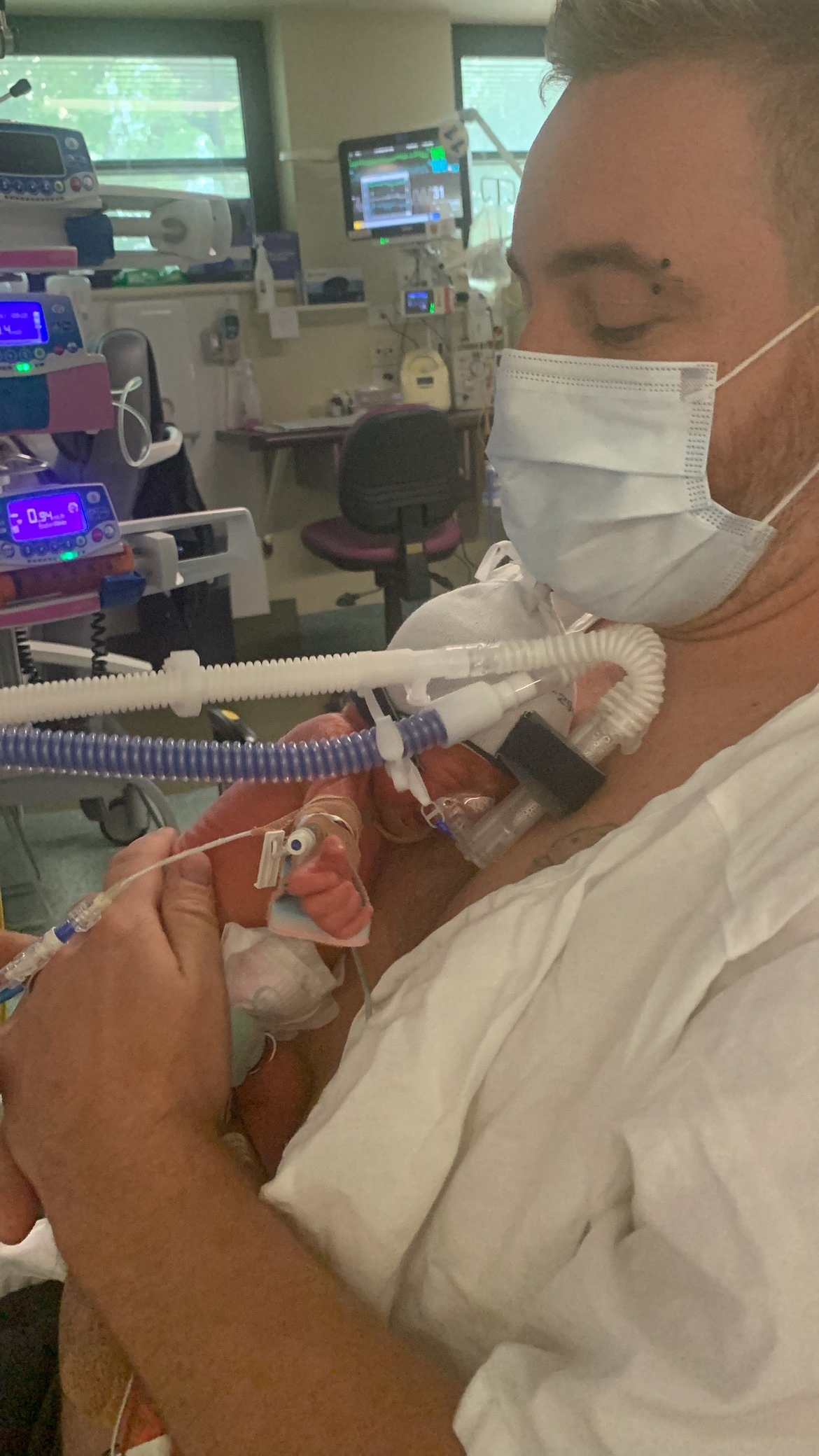
When I watched my son being resuscitated — multiple times — within hours of birth, it was surreal.
His O₂ levels were dropping on the screen. The mask that should have reversed the numbers wasn't.
84% … 82% … 80% … 78% …
A nurse, seeing my face, said: "It's OK — we're doing everything that needs to be done."
I asked about the number on the screen. I was given a target of 65%. Unnerving — because everyone around me looked helpless. I didn't know it then, but those numbers were falling through a gap in the research these people had been trained on.
They had a plan for when it hit 65%, and hope it didn't in the meantime. That was obvious from the alarms, the pagers, and the bodies flooding the space around JJ.
What nobody in that room knew was that I was connecting with my son — not the declining number on a monitor, but something underneath it, something I couldn't name yet.
Not in him. In me.
Before JJ — 31 August 2022, K'Gari
Shanah and I were getting married on Fraser Island — K'Gari — on 31 August 2022, about fifteen weeks into the pregnancy with JJ. On our wedding day she had a massive bleed. Paramedics met the ferry. Shanah was given options about what came next. We still got married, and then we came home to Sydney with the pregnancy carrying on.
Pre-eclampsia followed — her body, the placenta, and the baby struggling to communicate the way they should have been. Weekly visits to the high-risk blood pressure clinic at the hospital. Her previous pregnancies had already ended with pre-eclampsia, but this time it was worse. His due date was 14 February.
Birth and separation — 28 December 2022
On 28 December we went to the high-risk blood pressure clinic at the hospital. That visit became an emergency caesarean. JJ was born at 32 weeks. When he arrived, Shanah went into intensive care for hours. At one point her heart rate spiked to 210/140 before she blacked out. There was organ damage. She was in pain. And upstairs, completely unknown to her, JJ was already fighting for his life.
He was resuscitated in the birthing suite while Shanah was still being sewn up — within minutes of delivery. I left with him, believing she was heading to recovery. That was when the desats began.
She was meant to be up in forty-five minutes or so. Well after that time had passed, and she still wasn't in recovery, I found out where she was. ICU. I had to go down and see her.
The ICU doctor looking after Shanah made it clear she was in a bad way — heavily medicated, her blood pressure affecting her cohesion. But all she wanted to know was how JJ was doing.
I had to explain in the only way she knows me to talk: honestly. I softened the message without lying, but without shedding the feelings of fear, uncertainty, and confusion onto her either. She got the controlled, honest answers — which made it easier a few hours later, when, before JJ was transported, I worked with the hospital staff to bring him to her.
Desats and intubation
What followed was a chain of interventions. The turning point came with intubation — harder on a newborn than anyone outside the room can appreciate. It took several attempts. I asked to watch, and I pushed, but in the end I took the advice that no parent would want to witness it. That may be true for most people. For me, it remains a regret.
Intubation means pain relief. It is traumatic for a baby. There is evidence that JJ received excessive morphine, which then triggered further desats. After many hours — with Shanah still critically unwell downstairs — the decision was made to transfer him to higher care on NETS.
Before that happened, they brought JJ to her. She could barely see. She could barely talk. But she sure could cry — tears of joy as he was wheeled in through his ICU transport crib. She held his hand. Minutes later, I was leaving in the NETS ambulance to drive an hour away, the sun rising as we went.
NETS transfer
Me asleep in the front. JJ behind me. I was able to talk, but like most parents the NETS team deal with, I think they just knew to let me sleep.
When I woke to the alarm, they explained the extent of the desat event. When I could hear the beeping of stability again, I shut my eyes and slept for another fifteen minutes.
There were hospital ringarounds and a wait for a bed. Eventually RPA was confirmed — a long way from Shanah, still in intensive care at Campbelltown.
Exhaustion and reunion
The next few days blurred together. Later I slept in a makeshift dorm at the hospital for a couple of hours at a time. A newborn in the city. Shanah in intensive care in the suburbs. Five children at home, a couple of days after Christmas, in the middle of the school holidays.
Family rallied around us, picking up every piece I was dropping.
Within a few days Shanah was transferred to RPA as well. That was the game changer — still very unwell, but finally with her baby for more than minutes. And he was kicking goals.
I signed JJ onto donor breast milk as soon as RPA offered it. Nothing beats a mother's milk, but I was grateful another mother could step in for the moment Shanah could not. After weeks in special care back at Campbelltown, Shanah and I decided on 26 January that it was time to bring him home. We needed to put our family back together.
JJ's fingerprint
We recognised signs of autism in JJ early. I am tuned to pattern detection. Shanah grew up with a brilliant lawyer stepfather who had Aspergers, and with two autistic siblings she had watched grow from birth into their thirties. Her stepfather has since passed. JJ held no surprises for us.
Over the years I studied him through relationship and interaction, and I read everything I could find on autism. Speech regression at eighteen months. Food aversions. Ways of building relationship that were different from our other children — but natural to all of us, all the same.
The effect is his personality — not a label on a spectrum, but a fingerprint formed in the womb and embedded in who he is. The same as anyone else. Only his.
I could see the pieces spread across the research, but nobody seemed to be putting them together. When the time came, I knew I needed to build something for JJ — so that as he grows older there might be a system that helps him navigate the world. Something designed not to fail, to close the edge cases that hurt people like him.
The research — subline, not the story
The papers came after. They are not why this page exists. They are what I built when the questions outran what medicine could answer in the room where my son was dying.
My wife had pre-eclampsia. She was in intensive care three floors down. JJ's oxygen dropped in the hours after delivery. Nobody could tell me why one membrane — the one that was supposed to protect him — failed while the rest of his body fought to hold.
So I went looking.
This chain is the bridge between physics and the failure mode that nearly killed my son.
The algebra runs from α⁻¹ = 137.035999177 through Bohr radius, O–H bond length, aquaporin pore width, membrane selectivity, to arterial O₂ at 98%. Six links. One dimensionless constant to biology's most fundamental filter.
When that coefficient holds, it's called breathing.
When it fails at the placental boundary, it's called pre-eclampsia.
When it reaches the fetal brain through matched blood with no counter-regulation, it's what happened to JJ.
SECS exists because one child needed a system that would never fail him.
Run the script. Check the algebra. Then tell me 137 is just a constant.
— Jay, for JJ and Shanah